Kid Zone Academy 2 is all about making quality childcare accessible, warm, and family-friendly.
We’re proud to be one of the most affordable childcare options in St. Pete. Many of our parents receive free childcare through ELC, and a big reason is that we don’t stack on extra fees. That means more support for families and fewer surprise costs.
We’re also a bilingual school, giving children the chance to grow their language skills early in a natural, supportive environment. We accept ELC and VPK, and all meals are included, which makes daily routines easier for parents and helps kids stay fueled and ready to learn.
If you’re looking for a place where affordability, language, and care come together, Kid Zone Academy 2 is ready to welcome you.
Preschool problem solving activities include puzzles, shape sorters, cup-stacking challenges, bridge building, and mystery bag games. Each one lets a child try an idea, see what happens, and adjust before an adult steps in. Start with tasks matched to the child's current skill level.
Puzzles and shape sorters let children test a piece, see it doesn't fit, and try another spot.
Keep memory and sorting games to about 10 minutes so they stay fun.
The Cup-Stacking Challenge takes 10 minutes and uses 6 to 10 paper or plastic cups.
Try not to finish the puzzle for the child; give them a few extra seconds to work it out.
Schedule outdoor play before 10 a.m. or after 4 p.m. from May through September in St. Petersburg.
Want to see problem solving in action?Kids Zone Academy offers hands-on preschool learning in St. Petersburg, Florida.
Preschool activities for problem solving are one of the simplest ways to build a child's thinking skills. Problem solving starts earlier than many parents expect.
Problem solving means figuring out what to do when something doesn't work the first time. A toddler fitting a square block into a round hole is already doing it, as is a four-year-old who rebuilds a fallen tower.
Trying a new idea instead of giving up
Asking for help in a clear way
Noticing patterns and cause-and-effect
Staying with a task a little longer each time
Problem-Solving Activities for 3- to 5-Year-Olds by Skill Level
A three-year-old and a five-year-old can both practice problem solving, but tasks should match where each child is right now. Start with something a child can finish with some success, then raise the difficulty slowly.
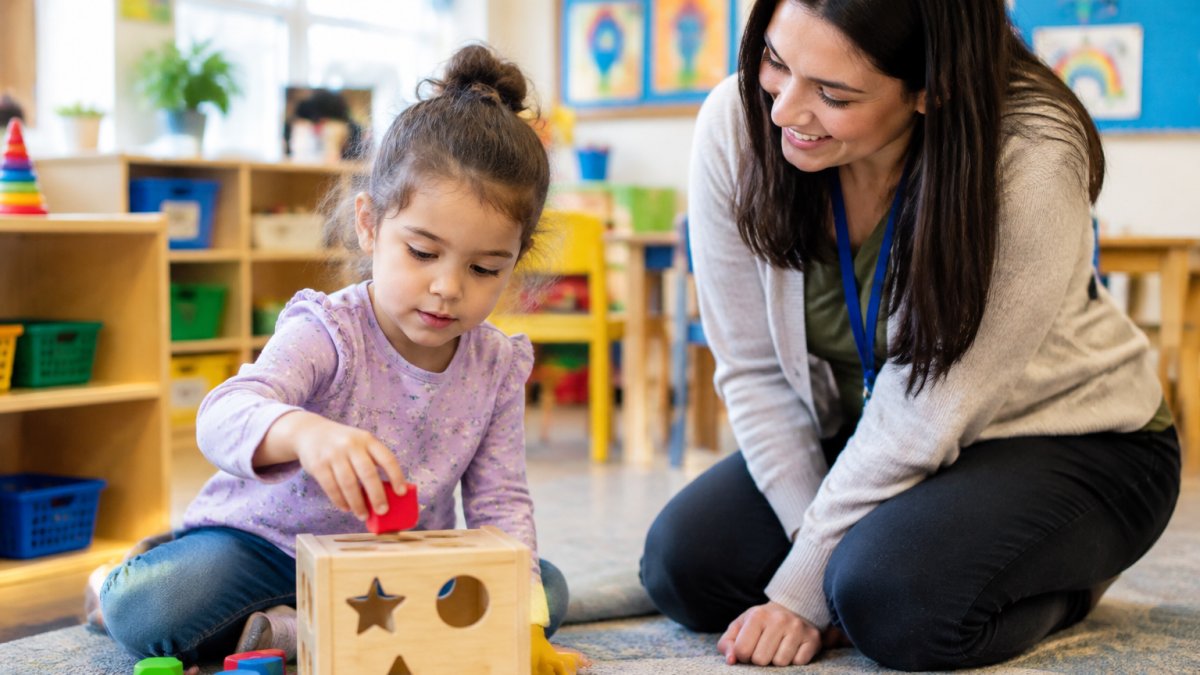
Preschool child engages in problem solving by fitting shapes into a wooden sorter as a teacher observes
Use this simple guide when you pick activities:
Skill level
What it looks like
Example activity
Beginner
Matches by color or shape
Simple shape sorter
Building
Fits pieces with a bit of trial and error
Four- to six-piece puzzle
Advanced
Plans steps and explains choices
Pattern block challenge
If a child gets frustrated, step back to an easier level.
Puzzles and Shape-Sorting Tasks
Puzzles and shape sorters are among the most useful tools for early problem solving. A child tests a piece, sees it doesn't fit, and tries another spot, that loop is the heart of the skill.
Here is how to run a simple shape-sorting task:
Place three or four shapes on the table.
Ask the child, "Which hole do you think this one goes in?"
Let them try before you help.
If they struggle, point to the shape's edges without taking the piece away.
Try not to finish the puzzle for the child, and give them a few extra seconds to work it out.
Memory and Sorting Games
Memory and sorting games give children practice holding information in mind and grouping things into categories.
Memory match: Flip two cards and say what you see. Keep matching pairs.
Sorting: Ask the child to group buttons by color, size, or shape.
Silly grouping: Ask, "Which one doesn't belong?" and let them explain.
Keep sessions to about 10 minutes so they stay fun.
Preschool Problem-Solving Games You Can Set Up Quickly
Quick games work best when the adult sets a clear goal, gives the child room to try, and resists solving the problem for them. These four setups use common items and can be adapted across ages 3-5.
1. Clue-by-Clue Treasure Hunt
Age range: 3-5
Materials: One small toy or sticker, three to five index cards or sticky notes, a pencil
Setup: Hide the item in a familiar room. Write or draw one clue per card, each pointing to the next location (for example, "Look where we keep the spoons"). Place the first card where the child can see it.
Steps: Hand the child the first clue. Ask, "What does this tell us?" Let them move through the room and find each next card. The final card leads to the hidden item.
Time: 10-15 minutes
Cleanup: Collect the cards and return the item.
2. Cup-Stacking Challenge
Age range: 3-5
Materials: 6-10 paper or plastic cups, a flat surface
Setup: Clear a table or floor space. Place the cups in a pile.
Steps: Ask, "How tall can you make a tower before it falls?" Let the child stack. When it falls, ask, "What would you try next time?" Invite one rebuild with a change.
Time: 10 minutes
Cleanup: Nest the cups and store.
Adaptations: For beginners, start with three cups and a wide base. For advanced children, ask them to build a tower that can hold a small toy on top. For children with fine-motor differences, use larger cups or a non-slip mat.
3. Bridge Builder
Age range: 4-5
Materials: Wooden or foam blocks, one hardcover book, three to five toy cars
Setup: Place two block stacks a short distance apart and lay the book across them to form a bridge.
Steps: Ask, "How many cars can cross before the bridge falls?" Let the child count as cars cross. Then ask them to make the bridge stronger using more blocks.
Time: 15 minutes
Cleanup: Return blocks and cars to their bins.
Adaptations: For younger children, use a wider bridge and fewer cars. For older children, ask them to predict the number before testing. For children who prefer sensory input, use textured blocks.
4. Mystery Bag
Age range: 3-5
Materials: A cloth bag, four to six familiar objects of different shapes and textures (a spoon, a ball, a block, a soft toy)
Setup: Place the objects in the bag out of sight.
Steps: Ask the child to reach in without looking and describe what they feel. Then ask them to guess the object before pulling it out.
Time: 10 minutes
Cleanup: Return objects to their places.
Adaptations: For beginners, use two objects with very different textures. For advanced children, ask them to find a specific object by touch alone. For children with tactile sensitivity, offer a see-through bag or let them watch the objects go in first.
Across all four games, the adult's job is to ask one open question and let the child try before offering help.
Building and Pattern Challenges That Build Reasoning
Building and pattern work gives children practice planning before they act. A child building a tower thinks about balance; a child copying a pattern notices what comes next.
Pattern blocks are a strong option. Start with a simple repeat, such as red-blue-red-blue, and ask the child to continue it. Then give them a pattern to copy with a different shape.
Fort building is another favorite: a sheet over two chairs becomes a shelter, and the child figures out how to hold it up. Ask, "What happens if we move this chair?" to invite reasoning.
Start with two-step patterns, then add more steps
Let children explain their building choices out loud
Praise effort, not just the final result
Play-Based Learning Activities for Preschoolers, Indoors and Outdoors
Play-based learning gives children many chances to practice problem solving, and setting matters. In St. Petersburg, Florida, heat, humidity, and summer thunderstorms shape when and where families can play. These ideas pair indoor and outdoor activities with local options and simple weather rules.
Indoor Play-Based Setups
Pretend grocery store: Set out empty food boxes, a toy cash register or a shoebox, and play money or index cards. Ask the child to sort items into categories, then to "pay" for a purchase. This builds categorization, counting, and planning. Keep it to 15-20 minutes and store items in one bin for quick cleanup.
Found-object art: Offer paper cups, cardboard tubes, tape, and paper. Ask, "What can you build that stands up on its own?" Let the child test and revise. Use child-safe scissors and supervise tape dispensers with sharp edges.
Puzzle and pattern station: Set out a 4-12 piece puzzle and pattern blocks. Ask the child to complete the puzzle, then to make a pattern of their own and explain it.
Outdoor Play-Based Setups
Water-tube exploration: At a water table or a shallow bin, offer plastic tubing, cups, and funnels. Ask, "How can we make the water go through the tube?" This builds cause-and-effect reasoning. Empty and rinse the bin after use, and never leave standing water unattended around young children.
Obstacle course: Use cones, sidewalk chalk, and a jump rope. Ask the child to plan a route and then test it. For older children, ask them to change one part to make it harder.
Nature sorting walk: Collect leaves, seed pods, and small rocks, then sort by size, color, or texture. Avoid picking plants in parks and stick to fallen items.
St. Petersburg, Florida, Places to Try These Activities
St. Pete Pier and waterfront parks: Open space for obstacle courses and nature walks in the early morning. Bring water and sun protection, and plan to leave before midday heat.
Weather and Indoor/Outdoor Adaptations for St. Petersburg
Heat and humidity: Schedule outdoor play before 10 a.m. or after 4 p.m. from May through September. Bring water, use shade, and watch for signs of overheating such as flushed skin or unusual tiredness.
Summer thunderstorms: Summer in St. Petersburg often brings afternoon thunderstorms. Keep an indoor backup plan ready, such as a puzzle station or a pretend-play bin.
Rainy days: Use library children's areas, indoor recreation centers, or a cleared room at home for obstacle courses made from pillows and tape lines.
Cooler months: December through February often bring milder afternoons that work well for park visits and nature walks.
Safety and Supervision
Supervise water play at all times, even in shallow bins. Check playground equipment for hot surfaces before use. Avoid small parts with children who still mouth objects, and keep an eye on children near streets, parking lots, and open water at parks. For any public location, confirm current hours, rules, and age requirements before visiting.
Free Printable Preschool Activities for Problem Solving
Printables add structure to home learning without buying a kit. A simple search for free preschool printables turns up maze pages, matching cards, and counting sheets. Check that the activity fits the child's skill level before printing.
Good printable choices include:
Maze worksheets for hand control and planning
Matching cards for memory practice
Simple pattern strips to continue
Shape-matching pages for sorting
Print one or two pages at a time. A short, focused task beats a long worksheet that leads to frustration.
Booking a Preschool Program in St. Petersburg That Builds Problem Solvers
If you want a program that builds these skills every day, Kids Zone Academy offers a nurturing preschool setting in St. Petersburg, Florida.
Parents often ask about cost before visiting. Pricing depends on the program and schedule, so contact Kids Zone Academy directly or visit our website for current pricing and enrollment details.
Ready to see how we support problem solving in the classroom? Register with Kids Zone Academy today and give your child a head start.
Frequently Asked Questions
What are some good problem-solving activities for preschoolers?
Good starting points include shape-sorting puzzles, sorting objects by color or size, simple building challenges with blocks, and memory card games. Each activity asks a child to notice a problem, try a solution, and adjust when it does not work. Start with tasks that match the child's current ability, then add one new variable at a time, such as fewer pieces, a time limit, or a missing part. Rotate activities weekly so children practice reasoning in different ways.
What problem-solving activities are appropriate for 3- to 5-year-olds?
Three-year-olds usually do best with two- to four-piece puzzles, simple sorting by one attribute, and stacking challenges with large blocks. Four- and five-year-olds can handle longer puzzles, sorting by two attributes, pattern block tasks, and build-a-bridge challenges using household items. Adults should prompt rather than solve. Asking What else could you try? keeps the child in control of the thinking.
How can play-based learning help preschoolers develop problem-solving skills?
Play gives children a low-pressure setting to test ideas, make mistakes, and try again. A child building a block tower that keeps falling learns about balance and base size without being told. Pretend play, such as setting up a store with limited coins, requires planning and flexible thinking. Teachers and caregivers support this by asking open questions and waiting before offering help, which builds persistence and independence over time.
How do I know if my preschooler is ready for harder problem-solving tasks?
A child who completes a task independently most of the time, without frustration, is ready for a small step up. Watch for trial and error, where the child tries several approaches before asking for help. If a task causes repeated distress or quitting, reduce the number of pieces or add a visual model. You can ask Kids Zone Academy about how activities are adapted for individual children when you contact the school.